

HLA Typing Market to reach USD 1.78 Billion by 2035 at 7.65% CAGR
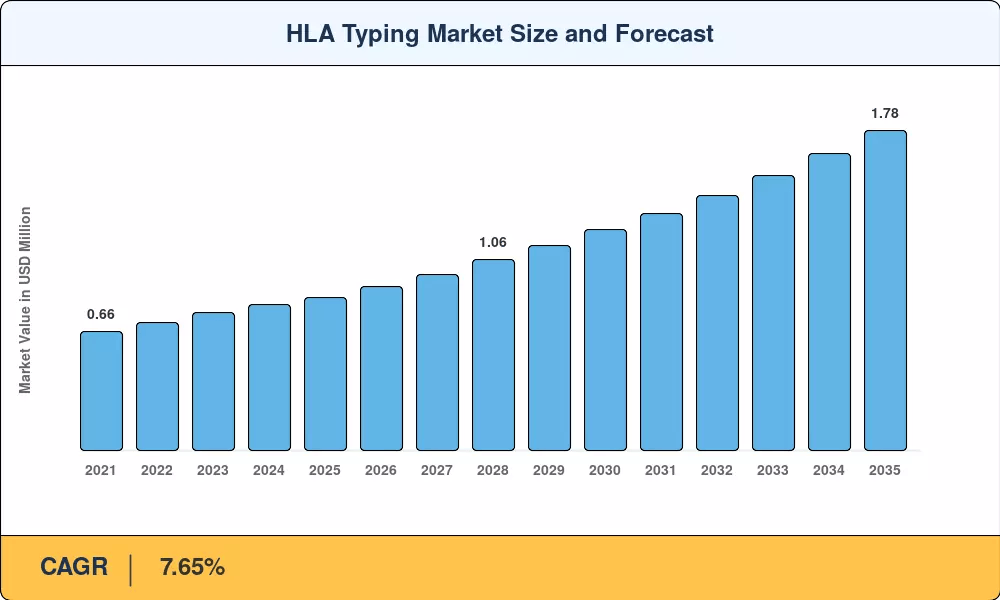
HLA Typing Market Size
HLA Typing Market to Surge from USD 0.91 Billion in 2026 to USD 1.78 Billion by 2035--- Powered by Next-Gen Sequencing, Precision Medicine Mainstreaming
NY, CA, UNITED STATES, June 10, 2026 /EINPresswire.com/ -- As per Market Research Future, the global HLA Typing Market size to reach USD 1.78 Billion by 2035 from USD 0.91 Billion in 2026, at a CAGR of 7.65% during the forecast period 2026--2035. The market base was estimated at USD 0.85 Billion in 2025.The 7.65% CAGR---anchored by record organ-transplant volumes and the mainstreaming of precision medicine---is driven by three converging structural forces: the global shift from serological assays and low-resolution antibody panels to next-generation sequencing HLA analysis platforms that resolve alleles at full resolution, the regulatory acceleration of performance-based reimbursement policy rewarding precise tissue matching, and the emergence of cloud bioinformatics platforms capable of delivering allele-level immune gene matching within 48 hours.
National governments are amplifying this momentum. The U.S. recorded more than 48,000 organ transplants in 2024 per the Organ Procurement and Transplantation Network, each requiring donor-recipient compatibility workups. The Medicare IOTA Model, launched in January 2025, now ties hospital payments to transplant outcomes and indirectly rewards precise tissue-matching diagnostics through performance-based hospital payments. The U.S. National Marrow Donor Program has standardized high-resolution typing for unrelated donor searches. Together, these initiatives are creating the population-scale datasets on which immune gene matching and tissue matching diagnostics depend.
Request A Free Sample: https://www.marketresearchfuture.com/sample_request/21479
Key Market Trends & Growth Drivers
Rising Organ-Transplant Volumes
Transplant activity sets the baseline for human leukocyte antigen testing demand and is the single largest structural driver of the HLA Typing Market through 2035. The U.S. recorded more than 48,000 organ transplants in 2024, each requiring donor-recipient compatibility workups across waitlist, crossmatch, and post-transplant monitoring stages. Every additional transplant generates multiple typing events, making transplant growth the single most reliable demand engine for the HLA Typing Market.
Early-adopter health systems report that high-resolution tissue matching diagnostics reduce repeat testing and improve graft outcomes. Spain's globally leading donation rates and the UK's NHS Blood and Transplant programs sustain steady human leukocyte antigen testing volumes across Europe. Brazil's publicly funded transplant system---among the largest globally by volume---anchors regional demand in South America.
Shift to Next-Gen Sequencing HLA Analysis
Laboratories are retiring serological and SSP-PCR workflows in favor of next-generation sequencing HLA analysis, which delivers unambiguous allele-level resolution. Sequencing-based tissue matching diagnostics now resolve ambiguities that legacy methods left open, reducing repeat testing and improving graft outcomes. The U.S. National Marrow Donor Program has standardized high-resolution typing for unrelated donor searches, and venture investment exceeding USD 200 million across diagnostics startups since 2023 signals rising confidence in this transition toward immune gene matching at scale.
Molecular assays command the largest revenue concentration in human leukocyte antigen testing, holding a 54.9% share of technology demand. Platforms from companies such as Illumina and Thermo Fisher Scientific can analyze multi-locus HLA profiles and deliver allele-level resolution in under 48 hours---compressing timelines that previously required weeks of specialist consultation. Molecular and digital hematology technologies are advancing at a 10.10% CAGR through 2035.
Precision Medicine Mainstreaming
Precision medicine extends immune gene matching beyond transplantation into pharmacogenomics and autoimmune risk stratification. The FDA's labeling guidance linking HLA-B57:01 status to abacavir hypersensitivity illustrates how immune gene matching now informs drug safety, broadening the clinical footprint of the HLA Typing Market well past its transplant origins. Research applications are expanding at a 9.65% CAGR as immune gene matching enters drug discovery pipelines.
In January 2025, CMS launched the Medicare IOTA Model, tying hospital payments to transplant outcomes and indirectly rewarding precise tissue-matching diagnostics---a milestone illustrating how precision medicine mainstreaming is directly accelerating immune gene matching commercialization. Allogeneic cell therapies depend on immune gene matching to limit graft-versus-host complications, and as CAR-T and stem-cell pipelines mature, developers need HLA-characterized donor pools, extending the HLA Typing Market into the therapeutics value chain.
Ask for Customization: https://www.marketresearchfuture.com/ask_for_customize/21479
Market Segment Insights
BY PRODUCT & SERVICE
Reagents & Consumables: Dominant segment with ~68.5% share in 2025. Recurring per-sample demand drives revenue; every typing event consumes assay kits regardless of platform, generating predictable recurring revenue. Thermo Fisher Scientific's SSP/SSO kits and QIAGEN's molecular HLA kits reinforce market leadership.
Instruments: USD 0.18 Billion revenue in 2025. NGS platform installations drive demand; a full next-gen sequencing HLA analysis suite can exceed USD 350,000 before reagent commitments. Illumina's NGS sequencers and TruSight HLA assays anchor instrument demand.
Software & Services: Fastest-growing segment at 9.15% CAGR (2026--2035). Cloud bioinformatics adoption and interpretation services represent a high-margin layer atop reagent revenue; subscription-based allele-calling platforms and cloud HLA databases convert one-time instrument sales into recurring income.
Other Products (Library Prep, Sequencing Reagents): 8.15% CAGR (2026--2035), representing next-generation workflow frontiers for immune gene matching protocols.
BY TECHNOLOGY
Molecular Assays: Dominant technology with ~54.9% share in 2025. High-resolution accuracy needs drive demand; molecular assays displace serological methods wherever allele-level resolution matters. NGS-based tissue matching diagnostics resolve ambiguities that legacy methods left open.
Non-Molecular / Serological: 8.15% CAGR (2026--2035). Confirmatory and rapid screening applications sustain steady growth; serological techniques retain a role in rapid antibody screening and confirmatory crossmatch testing as complementary tools rather than primary platforms.
PCR-Based Methods: Combined USD 0.28 Billion revenue in 2025. Supports real-time amplification and SSP/SSO workflows for transplant compatibility testing at population scale.
Sanger Sequencing & Others: 7.2% CAGR (2026--2035), representing legacy and specialized diagnostic frontiers for targeted locus analysis.
BY APPLICATION
Diagnostic Applications: Dominant application with ~68% share in 2025. Transplant compatibility workups and post-transplant monitoring anchor demand; each of the 48,000+ U.S. organ transplants generates multiple typing events across waitlist, crossmatch, and monitoring stages.
Research Applications: Fastest-growing application at 9.65% CAGR. Pharmacogenomics and immunology studies drive demand as immune gene matching enters disease-association studies and therapy development pipelines.
Donor-Recipient Cross-Matching: USD 0.22 Billion in 2025, driven by comprehensive compatibility profiling now standard of care in kidney, liver, and heart transplants.
Cancer Diagnosis & Prevention, Transfusion Therapy, Infectious Disease Testing: 8.5% CAGR (2026--2035), fueled by precision medicine mainstreaming and pharmacogenomic screening expansion.
BY END USER
Commercial Service Providers: Largest segment at ~43.5% share in 2025. Outsourced high-throughput typing drives demand; transplant centers increasingly outsource high-volume tissue matching diagnostics to specialized reference laboratories.
Hospitals & Transplant Centers: USD 0.27 Billion in 2025. On-site compatibility testing gains traction as regional hospitals gain sequencing capability.
Research Laboratories & Academic Institutes: Fastest-growing end user at 9.75% CAGR, reflecting expanding immunogenetics grant funding and drug discovery pipeline integration.
Other End Users (Blood Banks, Reference Labs): ~8% share; specialized testing for transfusion therapy and hematopoietic stem cell matching remains a foundational demand driver.
Read Detailed Insights: https://www.marketresearchfuture.com/reports/hla-typing-market-21479
Regional Outlook
North America --- Dominant Market (~41.8% Share, 2025)
The United States generates approximately 84% of North American HLA Typing Market revenue, driven by the densest transplant infrastructure globally, the Medicare IOTA Model reorienting hospital incentives toward precise tissue-matching diagnostics, and sustained NIH funding for immunogenetics research keeping the region at the technology frontier.
The U.S. recorded more than 48,000 organ transplants in 2024 per the Organ Procurement and Transplantation Network, each requiring donor-recipient compatibility workups. Canada is growing on provincial registry investment, contributing 11.5% of regional revenue. Mexico's expanding transplant centers contribute 4.5% of regional revenue.
Europe --- Second Largest (27.2% Share, 2025)
Europe's HLA Typing Market benefits from harmonized accreditation under EFI standards and dense cross-border donor cooperation. Germany leads regionally with 24% of regional share through transplant network density. The UK contributes 19.5% anchored by NHS donor registry programs. France holds 16% with Biomedicine Agency oversight. Italy contributes 11% through regional transplant hubs. Spain holds 10.5% with world-leading donation rates.
The Nordic Countries contribute 8% through Scandiatransplant cooperation. Russia is building centralized typing facilities at 5.5% of regional share. Spain's globally leading donation rates and the UK's NHS Blood and Transplant programs sustain steady human leukocyte antigen testing volumes across the continent.
Asia-Pacific --- Fastest-Growing Region (9.45% CAGR, 2026--2035)
Asia-Pacific is the highest-growth corridor in the HLA Typing Market. China holds 38% of regional share on national transplant reform and regulated organ-allocation system. India contributes 21% through registry expansion programs and a growing network of accredited laboratories. Japan holds 18.5% through aging population transplant demand. South Korea contributes 10% with advanced laboratory infrastructure.
ASEAN is growing at 7.5% on emerging transplant programs. The region accounted for USD 0.08 Billion in 2025. Public-private registry investments in India and South Africa open volume that scales tissue matching diagnostics as enrollment rises.
South America --- Growing Presence (USD 0.05 Billion, 2025)
Brazil anchors South America's HLA Typing Market at ~62% of regional revenue, with a large public transplant system among the largest globally by volume driving analyzer procurement. Argentina's INCUCAI coordination body standardizes tissue matching diagnostics nationally, contributing 23% of regional revenue. Emerging registry programs across the rest of South America support steady growth despite budgetary constraints.
Middle East & Africa --- Emerging Opportunity (USD 0.04 Billion, 2025)
Saudi Arabia's national transplant investment accounts for 34% of regional share. The UAE's medical-tourism infrastructure contributes 26%, building reference laboratories to support both domestic demand and medical tourism. South Africa's established immunogenetics centers extend advanced human leukocyte antigen testing across sub-Saharan referrals, contributing 22%. Egypt's growing transplant programs account for 11%. Capacity development across the rest of MEA creates incremental opportunities as WHO guidance on equitable transplant access encourages registry interoperability.
Competitive Landscape and Recent Developments
The HLA Typing Market is moderately concentrated, with an estimated Herfindahl-Hirschman Index in the 1,400--1,700 range. The top five companies control approximately 52--58% of global revenue, leaving a meaningful long tail of regional laboratories and niche reagent suppliers. Competition centers on sequencing throughput, bioinformatics depth, and accreditation breadth rather than price alone.
The competitive landscape is stratified between large-platform integrators controlling end-to-end sequencing and bioinformatics workflows, mid-sized specialty firms focused on specific transplant diagnostics, and bioinformatics-native disruptors reshaping discovery economics through cloud allele-calling platforms.
KEY COMPANIES AND RECENT MILESTONES
Thermo Fisher Scientific (September 2024): Expanded SSP/SSO kits and NGS reagents portfolio with enhanced software integration, reinforcing its position in molecular assay workflows. Estimated revenue share: ~16--19% of global HLA Typing Market.
Illumina (November 2024): Broadened TruSight HLA assay installed base through next-generation sequencing platform upgrades, strengthening high-resolution typing capabilities. Estimated revenue share: ~12--15%.
QIAGEN (March 2025): Launched updated sample prep and molecular HLA kits with improved workflow integration for transplant diagnostics laboratories. Estimated revenue share: ~9--12%.
CareDx (January 2025): Extended AlloSeq typing platform integration with transplant monitoring software, targeting large centralized transplant centers. Estimated revenue share: ~6--9%.
Omixon (November 2023): Partnered with European transplant centers to deploy automated Holotype HLA interpretation pipelines, expanding bioinformatics-as-a-service offerings. Estimated revenue share: ~4--6%.
GenDx (March 2024): Launched NGSengine software updates supporting newly recognized HLA alleles for immune gene matching workflows. Estimated revenue share: ~4--6%.
Future Outlook: 2026--2035
By 2030, AI-driven allele interpretation systems are expected to influence over 60% of HLA typing workflows in market leader countries, integrating machine-learning models that resolve phase ambiguity and predict epitope-level mismatch into unified clinical dashboards. Algorithms validated against transplant-outcome datasets promise to ease interpretation bottlenecks while raising the consistency of immune gene matching across laboratories.
Decentralized tissue matching diagnostics incorporating portable sequencing and pooled-service models are projected to extend high-resolution typing to populations historically underserved by centralized reference centers by 2028, improving patient diversity and reducing access gaps by 25%.
The next decade will see market economics tilt from instrument sales toward recurring software and service revenue. Cloud-hosted allele databases and per-sample interpretation subscriptions create stickier customer relationships, with software and services projected to outpace reagent growth through 2035. Allogeneic therapeutics will pull immune gene matching deeper into drug development---as regulators clarify donor-characterization requirements for off-the-shelf cell products, HLA-typed biobanks become strategic assets, linking diagnostic laboratories to the broader therapeutics economy.
WHO guidance on equitable transplant access encourages registry interoperability, and decentralized tissue matching diagnostics should extend high-resolution typing to populations historically underserved by centralized reference centers.
Portable sequencing and pooled-service models will narrow the access gap, while the convergence with cell and gene therapy creates entirely new demand vectors for immune gene matching beyond traditional transplantation. The HLA Typing Market is poised to reach its USD 1.78 Billion 2035 destination as precision medicine mainstreaming and transplant volume expansion continue to align commercial and clinical imperatives.
More Related Research Insights:
https://www.marketresearchfuture.com/reports/transplant-diagnostics-market-1324
https://www.marketresearchfuture.com/reports/molecular-diagnostics-market-1171
https://www.marketresearchfuture.com/reports/immunology-market-30261
https://www.marketresearchfuture.com/reports/organ-transplantation-market-915
https://www.marketresearchfuture.com/reports/next-generation-sequencing-market-6354
https://www.google.com/search?q=Personalized+Medicine+Market+mrfr
https://www.marketresearchfuture.com/reports/companion-diagnostic-market-3077
https://www.marketresearchfuture.com/reports/genetic-testing-market-2009
https://www.marketresearchfuture.com/reports/stem-cell-therapy-market-6422
https://www.marketresearchfuture.com/reports/biomarker-market-1941
Larry Wilson
WantStats Research And Media Pvt. Ltd.
+1 855-661-4441
email us here
Visit us on social media:
LinkedIn
Facebook
YouTube
X
Legal Disclaimer:
EIN Presswire provides this news content "as is" without warranty of any kind. We do not accept any responsibility or liability for the accuracy, content, images, videos, licenses, completeness, legality, or reliability of the information contained in this article. If you have any complaints or copyright issues related to this article, kindly contact the author above.
